History Day team headed to nationals
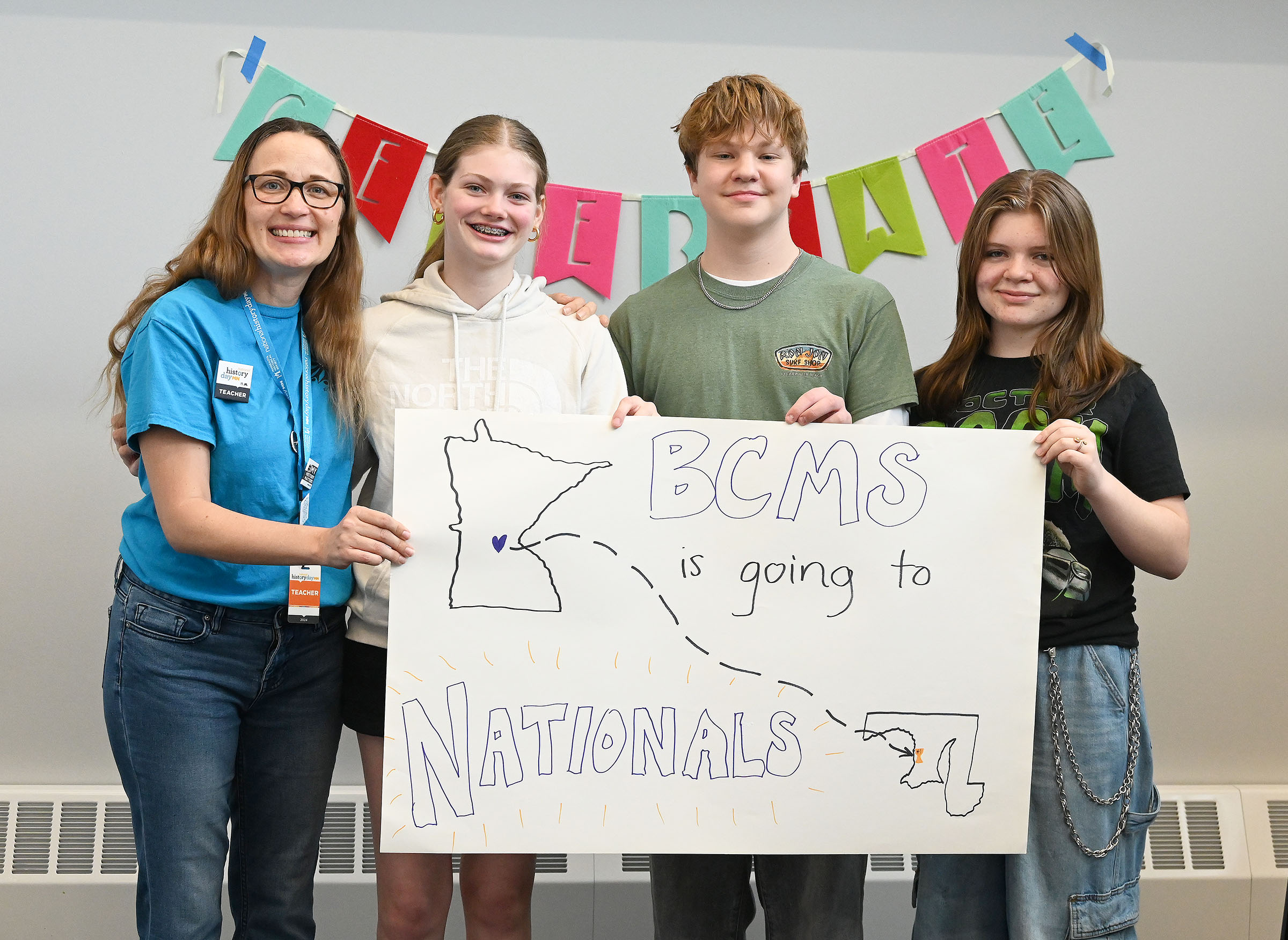
For the first time since 2020, and only the second time in the last 12 years, a trio of local students have earned the rare distinction of qualifying for nationals in the annual History Day competition.
Seventh-grader Dorothy Karson and eighth-graders Elsie Johanson and Henry Winger researched the impact of the Columbine school shooting in 1999, and changes to school security as a result. They presented their findings as a theatrical performance and advanced through school and regional competitions to finish in third place out of 28 teams at state.
That meant they were positioned as the first alternate if one of the top two teams was unable to compete at nationals, and they received word that they are going to Maryland this summer in a surprise announcement on April 23. Called down to the conference room by Principal Matt Lubben, they walked in to find their families and a representative from the History Day organization waiting to break the news. To say they were excited is an understatement.
“I started shaking,” said Karson.
“I think all of us were shaking,” said Winger.
“Reaching the National History Day competition is a significant achievement,” said their teacher, Danielle Kelm. “This trio earned that opportunity through years of effort from sixth grade until now. They took ownership of their learning and pushed beyond what was required. Their success also marks an exciting moment for our school as we return to the national stage. I am proud of their work and the compassionate performance they’ve crafted about a heavy moment in American history.”
A difficult topic
The genesis of this year’s project came during a routine safety event last fall.
“Henry and I were were in class and we were having a lockdown drill,” said Johanson. “I know why we have lockdown drills, but I was really curious as to when they started. So I asked my teacher and he said they really started up after Columbine. So I thought that might be an interesting project to talk about.”
With past experience working together in community theater, the three students naturally gravitated toward a performance rather than other History Day options like exhibits, websites or documentaries.
“We’re really good friends, so we figured it’d be fun to do a project together,” said Winger. “Once we thought of this topic it was something that we all were interested in and really wanted to pursue and keep talking about.”
All agreed that the topic was compelling.
“I feel a lot more connected with our project this year than I did last year,” said Karson.
“It’s because this is something that affects all of us,” said Johanson.
Researching the event, and its impact on school safety protocols in the years since, was a sobering experience.
“There have been times where we go to practice and we finish a performance and we talk about it, and then we just sit and be quiet for a while, because it can be really hard,” said Johanson.
Choosing to perform
While all three students had participated in previous History Day competitions in varying formats, all agreed that a dramatic performance was the right way to approach this topic.
“There are documentaries and exhibits and websites, but there’s not as much emotion with that,” said Karson. “It’s not as heartfelt.”
“Oral performance can be so much more powerful than a written paragraph because there’s a difference between reading something on a page and delivering it – feeling all the emotion and power behind it,” agreed Johanson.
One other benefit is that a performance draws attention.
“Naturally, a lot of people want to come see the performances,” said Winger. “Going into this, it’s really important to us to spread our message through our project.”
Advancing through competition
The trio has honed and refined its presentation at each level of competition. They began to realize they had something special going after the first two rounds of school and regional competition when judges only took a few points off.
“In sixth grade I took fourth place at state, but this project is much better and more well-made than my sixth-grade project,” said Winger.
Although they had done state-level work before, making it to the national competition wasn’t exactly a goal.
“My thought was, 'I want to do really good at state and I want people to hear our project and our message, but I’m fine if we don’t move on to nationals,’” said Johanson.
“We never really thought, ‘Oh, I really want to make it to nationals,’ because it just felt so out of reach,” said Winger.
But when they placed third at state, becoming the first alternate in line qualified for nationals if the first- or second-place team declined the trip, they began hoping for that opportunity.
“There’s always a chance,” said Karson. “Ms. Kelm told us how they place one through five in case someone drops out so then they can go to the next group.”
When the invitation to nationals came, all the hard work paid off.
“I’m grateful for the opportunity to go,” said Johanson.
“I feel bad that the other team can’t go, but I’m also very thankful,” said Karson.
Kelm explained to BHM School Board members during their May 11 workshop that the group will meet other students from around the country at the University of Maryland, and also have time to tour some of the sites around Washington, D.C.
“This is really exciting,” she said. “It’s really a thrilling thing to watch these kids from Buffalo get to go compete on a national stage.”