CIS World History students create museum displays
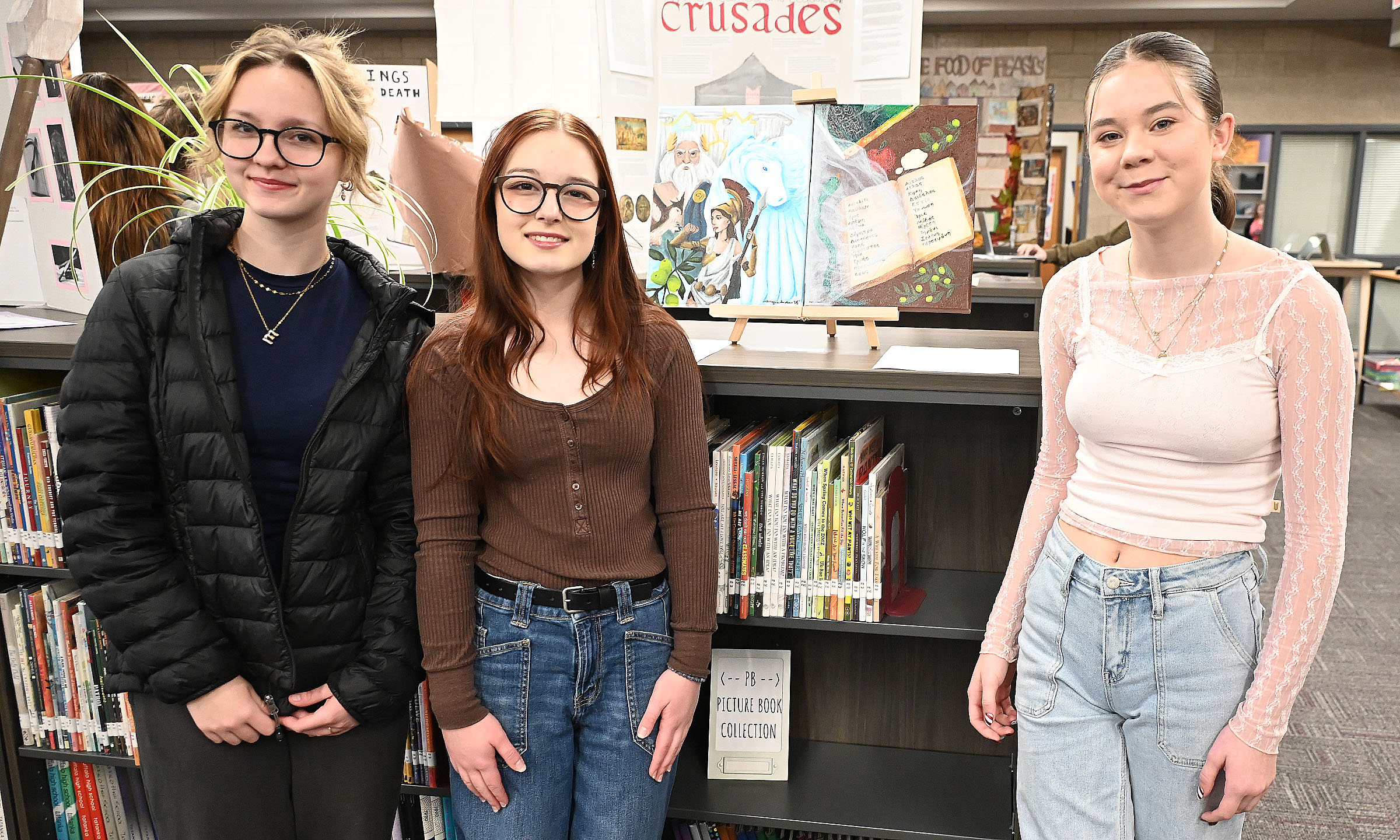
The Library Learning Commons at Buffalo High School serves many purposes on a daily basis. It is a social gathering place, an expansive classroom, a study hall and a resource-rich destination for research.
In mid-November, the space also became a museum gallery.
Students in Tara Rosh and Dwight Monson’s CIS World History classes were tasked with choosing one of more than 70 possible topics to study in depth, then creating artifacts and information about their findings.
“We designed the project like a museum exhibit with the idea of displaying it this way,” said Monson. “I wanted students to think about how they could demonstrate their knowledge in a creative way, and to an audience that isn’t a teacher. So the idea is that they’re creating an exhibit for classmates to learn more about their topic.”
“It gives us experience with museum work,” said junior Harlow Tierney, who along with Ailie Krueger put together a display about the Minoan religion. “When you walk into a museum it will speak for itself and you’ll understand what you’re learning just by looking.”
“It was definitely new, but fun,” said Krueger. “It’s more hands-on. You’re not just typing something up, but you can understand it deeper by making it or drawing it.”
Rosh credited Monson, who is teaching history for the first time this year in addition to business, for coming up with the idea of displaying research in a more engaging form.
“The boards are supposed to speak for themselves. We give them the opportunity to explain it to us, but any person should be able to walk by, look at what the students have produced, and get a good, concise understanding of the topic like you would in a museum,” she said.
Higher-level learning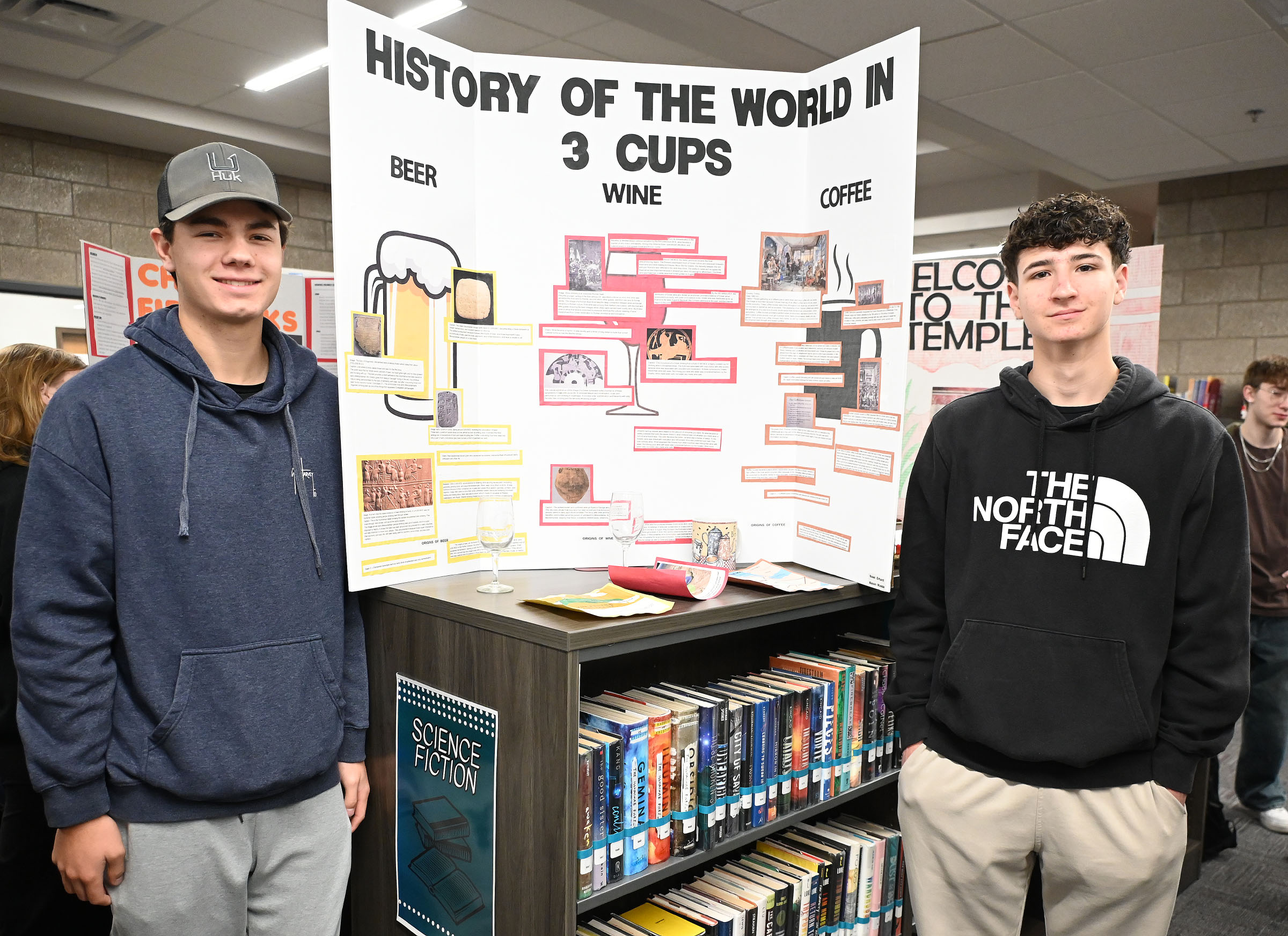
As a college-level history class, expectations and methods were a cut above.
“The timeline was really different from a normal history class. We had a month to do it, and most of our work was completed outside of class,” said Claire Martin, who along with Cora Smiglewski created a display on “Myths, Realities and Legacies of The Crusades.”
“There were a couple of work days inside of class, but in a regular history class most of our work time would have been in class, and we only would have had about a week,” added Smiglewski.
Rosh explained that students needed to use at least six primary sources and create at least two artifacts for their projects. In addition to the display, they had to write an abstract explaining their topic in a detailed yet accessible way.
“They could only use scholarly articles for their research. It couldn’t just be Wikipedia or Britannica. It had to be higher-level sources,” she said.
Krueger explained that Google Scholar was a helpful tool to locate books and other professional work on her subject.
“We didn’t just use AI,” she said with a laugh.
Other differences from a typical high school class included more freedom on topics and display guidelines.
“This required some more creative thinking, said Mason Mjelde. “You had to come up with an idea to make your display unique and visually appealing and support your presentation. You had to think of how you would make your project go from OK to really good. It can’t just meet requirements; it has to be better than that.”
“And there wasn’t a standard thing for everyone to follow,” said Mjelde’s partner, Isaac Erhard. “You had to come up with your own idea of how to present it.”
The pair’s topic was “The History of the World in 3 Cups.”
“Beer, wine and coffee did shape the social and economic side of early civilizations,” said Mjelde. “It was a big part of their culture.”
The final college factors were the need for skilled time management over an extended period, the high-stakes nature of the project – which accounted for 60% of students’ grades in the course – and a purpose that went beyond just describing the subject.
“The questions for the project were, why does this matter for world history, and how is this affecting the world today?” said Monson.
To that end, Ella Goodsen, Avy Weinhandl, Katie Sleavin and Maya Allen created a visually arresting painting depicting the characters of Greek mythology and other Greek symbols coming to life.
“It influenced storytelling because Greek myths gave a greater understanding about why humans act the way they do,” said Weinhandl. “That influenced people to start writing poems and stories, architecture, paintings and art. It gave them an idea of a new way to bring stories to other people.”
While the projects challenged students in new ways, they generally enjoyed the process.
“The most fun was making the posters and artifacts because you just worked together and had fun with it,” said Smiglewski. “The hardest part was probably the research and putting it all together.”
Erhard agreed.
“The hardest thing was finding the right sources, but it was good to see the results,” he said. “It was a cool project. I’d say the best part was seeing what it looked like when it was all put together.”
Rosh and Monson were pleased with the outcome as well.
“From what I saw, they definitely rose to the challenge,” Rosh said.
“I think some of them are unbelievable,” said Monson. “Some of them blew my expectations away.”